


One of the most inspiring things, at the end of your first tour of a distillery, is to think back to what you expected before you walked in. Instinctively, the moment you heard of that brand for the first time comes to your mind, as well as the first time you tasted something or the first time you read about it. Lo and behold, what you expected is almost always different from what you discover at the distillery. Guaranteed. And Lakes distillery is no different.
Actually, Lakes didn’t used to be the main topic of conversation between whisky passionates. Bejia Flor has been importing it in Italy since 2017, but during the last festivals before the pandemics the few bottles on the stands were often snubbed without too much remorse. Then, thanks to the recent flowering of single malt distilleries in England, the name began to circulate, together with the various Bimber, Filey Bay, Cotswolds… And at the Newcastle Whisky Festival in 2020 the first approach was made: curious bottles, a quatrefoil logo, the images of the Lake district in the brochures, the excellent impression of the Whiskymaker reserve No. 2… In short, curiosity brooded for months in silence and in August, after a long wandering among the spectacular landscapes where Wordsworth’s Romanticism was born, we decided to pay a visit just to have a look. And a sip, of course…

Located in Cockermouth, where the Derwent flows into the Bassenthwaite (the District’s only real “lake”), the distillery lies at the Northern end of the National park. Thirty miles further North, beyond the Solway firth, there’s Scotland. But here we are on the proudly English land, where whisky flows from the stills without strict specifications and where experimentation is a national sport in the field of distillation. And also in the field of breeding, since next to the distillery graze no sheep, but Andean alpacas…
Anyway, the day is sunny and the parking lot – where the names of the founders of the company stand out on the barrels – is alread almost full. The appointment with Andy Boughey, the export sales director, is at 11 o’clock, but we’re early, so we can have a look around. The slate buildings are charming, and do not look “new” at all. Behind a vaguely Art Nouveau wrought-iron gate, a courtyard opens up: on the left is the shop, on the right the offices, the bistro is just in front of the entrance. Sitting at the tables, accompanied by a cup of coffee, Andy plays the role of the narrator and tells us the story of the distillery of the lakes.


First of all, we were right: the distillery’s small buildings don’t look modern simply because they’re not. In fact, this was a Victorian farmhouse where dairy cows were raised. It sat there ruined and Paul Currie, who along with his father Harold had founded Arran in 1995, had been watching it for a while. Then, when Arran was sold and the idea of starting another distillery gradually emerged, the farm seemed the perfect location: in the rainiest region of England, surrounded by rivers and streams, in the most popular tourist park of the Country and a stone’s throw from Scotland. It was really difficult to choose a better place for a distillery.

So, in 2011 the Currie family and partner Nigel Mills, who after selling his retail chain to the giant Tesco had a fair amount of cash and was also the owner of a hotel in Cockermouth, renovated everything and opened the distillery. The first single malt was released in 2015 and things have changed a bit since then. Started as a local phenomenon, soon becoming a nationwide company (it’s among the largest whiskey distilleries below Hadrian’s Wall), today Lakes is growing more and more on the international scene, with production tripling and now standing at 390 thousand liters of alcohol per year. But herein lies the first problem: being located within a restricted area such as a national park, expanding the distillery is not at all easy. The washbacks have recently increased from 4 to 12, but the Mc Millan stills (the wash still Susan and the spirit still Rachel) are only two. And this somewhat limits future plans to increase the production.

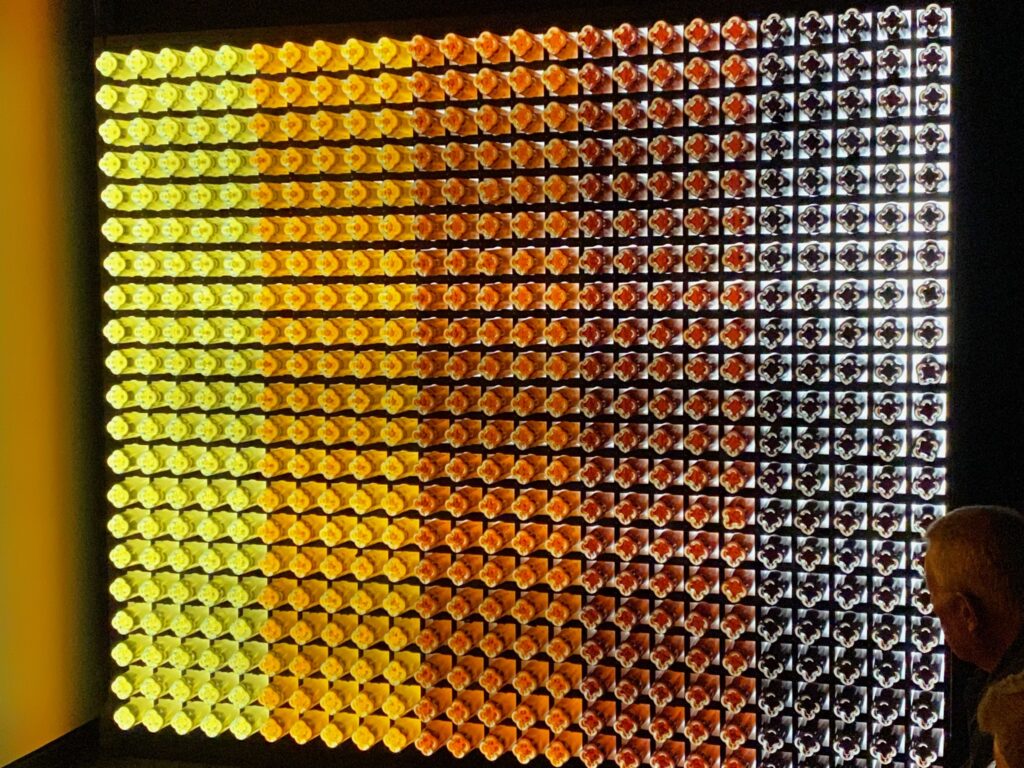
We mentioned expectations. During the tour, it becomes clear that the naive distillery located in a holiday destination is not what Lakes is used to. It is true that a quarter of the income comes from hospitality, but this is an old style and “craft” distillery in the highest sense of the word. The tour is useful to get an idea: mashing lasts 7 hours, fermentation lasts 4 days and it is done with a particular mix of yeasts. In a corner there is the beautiful copper still used for gin and vodka, but beyond the obvious economic utility (vodka and especially gin – which is incidentally very balanced – provide quick profit, unlike whisky), you never feel like you’re visiting an “industrial” distillery. On the contrary, if it weren’t for the accent of the staff (there are 75 employees in all), you could easily think to be in Scotland. Also because of the stone quatrefoils that adorn the walls: they have become the distillery’s logo and they help to create a Celtic atmosphere.
As the conclusion of the tour approaches, it’s time to talk about casks. Just talking about them, because unfortunately it’s not possible to see them – what a pity -, since the two warehouses are located a few miles apart. Eighty percent of the casks used are ex-sherry, a risky choice that again explains very well how quality is strongly sought after here. But in order to understand the level of absolute precision Lakes wants to achieve, you need to know the master distiller.

Dhavall Gandhi is the Willy Wonka of whisky: a genius, a madman, a scientist, a poet, a megalomaniac, a geek, a pioneer, a perfectionist, an incredible professional, an unstoppable talker. Born in India, he studied finance in the United States. Somewhere along the line – as the legend goes – he lost a flight and, just to kill time, he visited a Bourbon distillery in Kentucky. Epiphany. He came back home and told his wife that he was going to change his life, going to Scotland. The lady’s reaction is unknown. Anyway, he worked for Heineken in Edinburgh learning a lot about yeasts, then he worked for Macallan learning a lot about woods. He got a PhD in “oak studies” or something like that and he made the wood the focus of his life, the permanent center of gravity of his “holistic” approach to distilling.
Entering his world – as well as his off limits lab where he works locked with a team of 12 – can be a hallucinatory experience. In this reportage for Whisky Magazine, Dhavall explains in great detail (that’s how nitpickers are) his style. It is an obsession with woods, which are sourced according to strict specifications: three kinds of sherry (Oloroso, Fino and PX), but different levels of maturation, different varieties of oak, different origins of the trees. The barley can be bought already malted, but the focus is on wood, because it is the wood he “paints” with. The new make is a blank canvas, the casks are the colors.

Of course, next to the nerdy soul there is the artistic side of the craft, since “blending is the mother tongue of whisky”. Dr. Gandhi sniffs everything, checks non-stop and from cognac industry he has borrowed the practice of elevage: casks are often moved and the liquid is transferred during maturation in barrels of different types in order to reach a particular profile. Here lies the inversion of the process: often Dhavall starts from an idea (the scents of his grandmother’s house, a scene from a novel …) and directs the entire production and choice of woods to achieve that feeling.
At the end of the tour, it’s time to taste a couple of things. The vodka is a classic vodka, clean, precise, no spicy detours. The gin is bright, a serious and balanced London Dry gin. And the whisky? The one we are served is wonderful, the latest edition of the “Whiskymaker reserve” series, No. 4. Too bad it is sold out, though. Like almost all other single malt releases. And this is perhaps the biggest regret for an undoubtedly interesting and promising distillery: the lack of bottles for sale in the shop. The special releases are limited editions and they end up sold out in no time, and there is no “distillery exclusive” releases for visitors to buy. The 5 versions with 5 different finishing of the blended “The one” are available. As well the Steel Bonnets blended and two super-premium bottlings such as the inaugural release “Genesis” and some expressions of the Quatrefoil collection. Probably too little for a distillery with such a peculiar and curious style. So we look forward to an increase in production. We’re hopeful, also because Lakes distillery has been recently included in the BBC’s documentary series “Love letters from Britain”, dedicated to luxury brands such as Bentley, Dunhill and Balvenie. In short, we’re sure Lakes’ future will be bright and whisky enthusiasts will not be disappointed. Because for a whisky fans distilleries are like Nature for Wordsworth: “They never betray the heart of those who love them”.


Continues…


